
The Estonian gambling licence: what it actually means for a player
An Estonian licence is not a logo in a page footer. It is two separate permits, state supervision, tax-free winnings and a national self-exclusion register. Here is what each part means and how to check whether a casino is genuinely lawful.
"Licensed casino" is a phrase used by every operator, including those whose licence has no effect in
Estonia and protects an Estonian player in no way whatsoever. The word itself says nothing. What
matters is who issued the licence and what it lets you do when something goes wrong.
The Estonian gambling licence is the strongest option available to a player in Estonia. It is not a
marketing badge but a specific package: state supervision, tax-free winnings, a mandatory
self-exclusion register, advertising restrictions, and an authority you can genuinely complain to.
In this article we look at what that package consists of, what each part means for a player, how to
check in three minutes whether a particular site is lawful, and what you lose by playing
elsewhere. That last part is more honest than most articles of this kind: choosing to play at a
foreign site is not a crime and many people do it, but the choice should be made knowing which
protections disappear with it.
Two permits, not one
The commonest misunderstanding: there is no single "Estonian casino licence". There are two, and
both are required.
The activity licence (tegevusluba) is a company-level permit. It is issued by the **Tax and
Customs Board** and has no expiry date. The activity licence says this legal entity may in principle
organise gambling: its owners have been vetted, capital requirements met, the background of its
directors examined. It is a fitness check, not approval of a particular game.
The operating permit (korraldusluba) authorises a specific activity: which games, at which
address or on which website, and for how long. It is time-limited and must be renewed.
For remote (online) gambling there are technical requirements on top: gaming servers and their data
must be available to the tax authority in real time. This is what distinguishes an Estonian
licence from most offshore permits — the supervisor sees transactions, not just reports.
The basis is the Gambling Act, whose text in force is in the
Riigi Teataja.
How to check whether a casino is lawful
Three steps, three minutes in total.
1. Open the official register. The Tax and Customs Board maintains a public
register of lawful gambling operators.
It lists every operator holding an Estonian licence, together with the permitted domains.
2. Check the domain, not the brand. One brand may operate in several countries through different
legal entities. What counts is whether the exact domain you are playing on is on the list.brand.com and brand.ee may be two different companies with two different licences — or one
licence and one without.
3. If it is not on the list, it is not licensed. Whatever the footer says. Curaçao, Anjouan,
Costa Rica or some "international gaming authority" is not an Estonian licence, and no Estonian
supervision comes with it.
Blocking. Estonia also maintains a list of blocked domains — sites whose operator has no licence
and to which access is restricted. If a site does not open, or opens only over a VPN, that is not a
technical fault but an answer to the question of whether it is lawful.
What the licence gives a player
Five concrete things. Every one of them is absent when you play at an unlicensed operator.
1. Tax-free winnings. The Income Tax Act exempts from income tax a win from gambling organised
under an Estonian activity licence or a corresponding licence in another European Economic Area
state. A win at an unlicensed operator is taxable income that you must declare yourself.
2. HAMPI. The register of gambling restrictions is state-run self-exclusion: a single entry
applies at once across every Estonian-licensed casino, online and on the floor. It cannot be
cancelled on a momentary impulse, and that is precisely what makes it valuable. A foreign operator is
not connected to HAMPI and your entry means nothing there.
3. Mandatory identity verification. An Estonian-licensed casino must verify your identity, which
excludes minors and makes HAMPI work. It is friction with a purpose.
4. A right of complaint that actually works. If an operator does not pay or breaches its terms,
there is a supervisory authority with the power to intervene and ultimately withdraw the licence.
That is the heart of the matter: supervision without the power to sanction is a suggestion.
5. Advertising restrictions. Gambling advertising is tightly restricted in Estonia. You do not see
Estonian-licensed operators advertising everywhere, and that is not an accident.
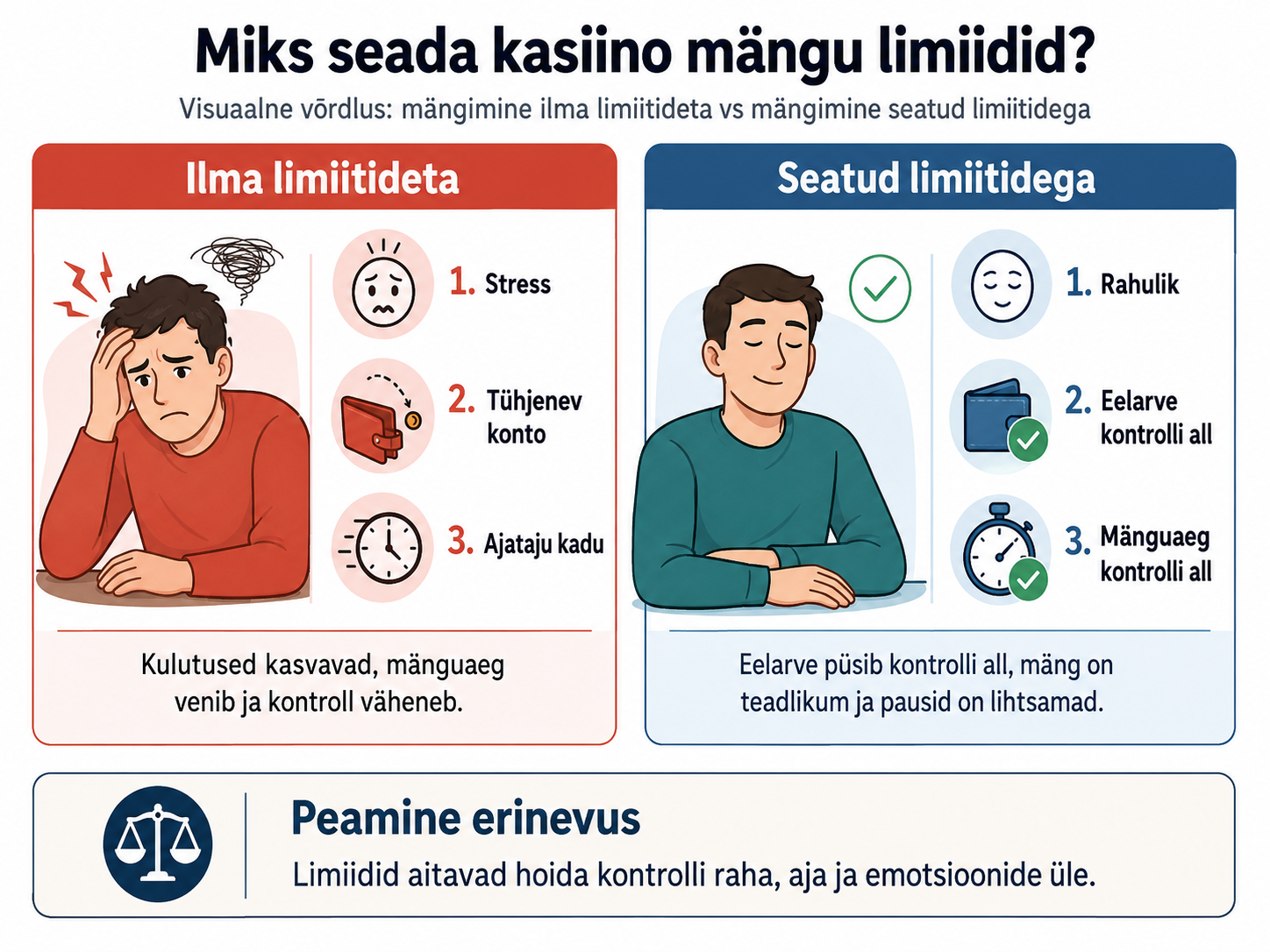
What you lose at an unlicensed operator
The honest side. Many Estonian players use foreign casinos, and this is not an offence **by the
player** — the restrictions bind the operator. But you lose four things at once.
The tax exemption. The win becomes taxable income. If the payout is in crypto, a second tax layer
is added for the disposal of the asset. Our sister site
kryptokasiinod.ee covers that in detail.
HAMPI protection. If you have entered yourself in the register, it will not stop you at a foreign
site. The register is national, not global.
Supervision. Curaçao's new system is better than what came before, but it is still another
country, another language, and proceedings whose outcome is not enforceable in Estonia. In practice
"I will complain to the licensing authority" rarely means getting money back.
Data protection and payout certainty. An Estonian-licensed operator works under EU data
protection and its solvency is monitored. With an offshore operator your only protection is its own
reputation.
That is why we keep one rule on this site: we state which licence each operator holds, and we never
call a non-EEA permit "licensed" without qualifying it.
Why Estonian-licensed casinos pay by bank transfer
Licensing and payment method are more closely connected than they first appear.
An Estonian-licensed operator must verify your identity. A bank link does this in a single step:
when you log in through Swedbank, SEB, LHV or Luminor, your identity has already been established by
the bank and the casino does not need a separate document photograph. This is where the whole
pay-n-play model comes from — the account is created during the deposit,
because verification came with it.
The practical consequences for a player are good:
- Withdrawals are faster, because KYC was done up front rather than at the moment of payout.
- Opening an account is faster — often a minute.
- Money moves between verified accounts, which reduces the risk of a freeze.
The trade-off is the absence of anonymity. You cannot play namelessly at an Estonian-licensed casino,
and that is deliberate. Anyone seeking anonymity goes elsewhere — and gives up everything listed
earlier in this article at the same time. It is a fair exchange whose terms are worth knowing.
How a bank link works technically is set out on a separate page,
how Trustly works.
An Estonian licence versus other EEA licences
For the purposes of the tax exemption, an Estonian and another EEA state's licence are equal —
the exception in the Income Tax Act covers both. Malta (MGA), Sweden (Spelinspektionen), Denmark and
other EEA states' licences qualify.
But in practical supervisory terms they are not the same.
An Estonian licence means the supervisor is here, proceedings are in Estonian, and HAMPI applies.
Another EEA state's licence means the tax exemption applies, but a complaint goes to that
country's authority, in that country's language and procedure. HAMPI does not apply, because it is an
Estonian register.
A non-EEA licence (Curaçao, Anjouan, Costa Rica) gives neither.
So the ranking from a player's point of view is simple: an Estonian licence, then another EEA
licence, then everything else — and the gap between the second and third is far larger than between
the first and second.
Our list of Estonian-licensed casinos contains only those
whose domain appears in the official register. We re-check it regularly, because licences change.
Gambling tax: where the money goes
A small part, but frequently asked about. An Estonian-licensed operator pays the state a gambling
tax whose rate depends on the type of game. For remote gambling the tax is calculated on the
difference between stakes and payouts — that is, on income actually earned.
The tax revenue is partly earmarked: a significant share is directed through the Gambling Tax Council
to support culture, sport, science and social projects.
Why does this interest a player? For two reasons.
First, it is why the state licenses at all: a regulated market is taxable and controllable, a
prohibited one is neither. The player gets protection, the state gets revenue, and that bargain is
the foundation of the whole system.
Second, it explains why an unlicensed operator is cheaper. It pays no Estonian gambling tax,
bears no licensing or compliance cost, and part of that difference reaches the player as a bonus. A
larger bonus at a foreign site is not generosity but a difference in cost structure — and one of
the cost components it omits is your protection.
What an operator must do to obtain a licence
The value of a licence comes from how hard it is to get and how easy it is to lose. In Estonia both
are serious, and that explains why the list is short.
Owner and director vetting. An applicant's beneficial owners must be identified and of impeccable
business background. Convictions for economic offences or an opaque ownership structure are
disqualifying. This is not a formality: it is where most murky applications fail, because the
ultimate owner of an offshore structure cannot be shown at all.
Capital requirement. An operator must hold the statutory minimum capital, which differs by type
of game. The idea is simple: an operator must be able to pay out winnings in a bad month too, and
capital is the first guarantee of that.
Technical compliance. Gaming servers, the random number generator and the accounting system must
meet requirements and be monitorable by the tax authority in real time. This point is constantly
underestimated. An offshore licence usually means a periodic report; an Estonian licence means the
supervisor sees the transaction flow itself.
Responsible gambling obligations. Mandatory integration with HAMPI, limit tools, a self-exclusion
facility, compliance with advertising restrictions.
This whole package of cost and obligation is why Estonian-licensed operators number in the dozens
rather than the thousands — and why their bonuses are more modest than those on unlicensed sites.
What happens when an operator breaks the rules
Here lies the entire difference between supervision and a logo. A licence is worth exactly as much as
the supervisor can do when something goes wrong.
In Estonia the Tax and Customs Board has a graduated set of interventions:
- A precept — an obligation to remedy the breach, with a deadline.
- A penalty payment — financial pressure if the precept is not complied with.
- Misdemeanour proceedings and fines.
- Revocation of the operating permit — closing a specific game or website.
- Revocation of the activity licence — the company loses the right to operate in Estonia at all.
The last is the nuclear option, and its existence is what makes the earlier steps work. An operator
whose entire Estonian business depends on a licence answers a support email differently from one for
which Estonia is one of dozens of markets and whose permit was bought from a registry on the other
side of the world.
The practical conclusion for a player. If an Estonian-licensed casino refuses to pay, you have an
escalation path: first the operator's own complaints procedure, then the supervisor. If a non-EEA
licensed casino refuses, you have an email address and hope. The difference is not a gradation but a
category.
Our methodology page explains how we assess operators and exactly what we verify
before anyone reaches a list.
How the Estonian market came to look like this
A short background helps explain why things are as they are.
Estonia regulated online gambling through the Gambling Act, which came into force at the
beginning of 2009. Before that the position of online games was grey: there was no local framework
and players used foreign sites. The act did three things at once — it created a licensing system,
imposed taxation, and gave the supervisor the power to block unlicensed sites.
The model Estonia chose is a licensed open market: a foreign operator may operate here, but must
take an Estonian licence and submit to Estonian supervision. This differs from a state monopoly and
equally from a completely free market. In practice it means many international brands you know
operate in Estonia under an Estonian licence — and some others you also know do not.
HAMPI was added later and is today the most distinctive part of the system. In most countries
self-exclusion is operator-based: you exclude yourself from one casino and another knows nothing
about it. The Estonian register is national and covers all at once, and in terms of player
protection that is a bigger thing than any licence condition.
Today's picture follows from that history: a comparatively small number of operators, strong
supervision, modest bonuses, and a very clear line between lawful and unlawful sites.
Licensing and payment methods: why some payments fail
A question we get constantly: why does a card payment to a foreign casino sometimes fail, even
though there is money on the card and the limit is sufficient?
The answer is that the payment chain is itself part of the supervision. Gambling transactions
carry their own merchant category code in payment systems, and banks and card schemes can see that
gambling is involved. Some banks block gambling transactions by default, or offer customers the
option of blocking them. With unlicensed operators the probability that a payment fails is
considerably higher.
Three practical consequences.
At an Estonian-licensed operator the payment usually works, because the bank and the operator are
both regulatorily in order and the nature of the transaction is clear. A
bank link goes straight from your account, without a card scheme in
between.
Unlicensed operators often use indirect routes — e-wallets, intermediaries, crypto. When a payment
travels through an intermediary whose name on the statement says nothing about gambling, it often
goes through — but that also means you have lost one more layer of transparency.
Bank-side self-protection exists. Several Estonian banks let a customer block gambling payments
themselves. It is not HAMPI and it does not reach everywhere, but it is a free extra layer that can
be switched on in online banking with a single click. If you have ever thought you would like an
additional obstacle, this is the simplest one available.
What an operator must disclose to you
A licence brings disclosure obligations, and they can be used as a checklist. If one of them is
missing, that is a signal in itself.
Operator details. The legal entity's name, registry code and address must be findable — not
hidden in the twelfth clause of the terms, but identifiable. Compare them against the official
register.
Game rules and payouts. The rules of each game must be available before play, not only
afterwards. That includes the chances of winning and the payout arrangements.
Full bonus terms. The wagering requirement, the deadline, game
weighting, maximum bet and maximum cashout must be stated before the
offer is accepted. A licence does not require them to be lenient — only that they be visible.
The complaints procedure. How and to whom a complaint is made, and within what time it is
answered.
Responsible gambling tools. Limits, a time out, self-exclusion, and a reference to HAMPI.
The prohibition on minors. A clear age limit and how it is verified.
If an operator does not disclose one of these, or makes it unreasonably hard to find, that is not
necessarily a breach — but it is a place to stop. Our methodology checks exactly these
points for every operator we allow onto a list at all.
A checklist before registering
Six points that take five minutes together and avoid most later problems.
- Check the domain against the official register. Not the brand name — the exact domain you
intend to play on.
- See which legal entity appears in the terms. If the company named in the terms is not the one
on the register, something is wrong.
- Look for a HAMPI reference. An Estonian-licensed operator must offer self-exclusion and refer
to it. If it is not mentioned anywhere, check point 1 again.
- Set limits immediately. A deposit or loss limit before your first game, not after your third.
It is a one-minute step that works when you least want it to.
- Read the bonus terms before accepting. A licence does not make a wagering requirement gentler.
Our Trustly bonuses page explains what to look for in typical terms.
- Save the operator's complaints procedure. It is in the terms and you need it only when
something goes wrong — but then it is too late to go looking.
If one of these points runs into trouble, it is not necessarily a sign of fraud. It is a sign that it
is worth asking before going further — and how quickly the operator answers that question is itself
information.
Three things a licence does NOT mean
Overestimating a licence is as misleading as underestimating it.
1. A licence does not make the game winnable. The house edge exists at a fully regulated casino
too. A licence guarantees that the RTP is what is claimed and that the random number
generator is audited — not that you win.
2. A licence does not remove a bonus's fine print. The
wagering requirement, maximum bet and
maximum cashout apply in exactly the same way. A licence requires
terms to be published, not to be more generous.
3. A licence does not replace your own limits. An Estonian-licensed casino must offer deposit and
loss limits, but setting them is your step. If you need stronger protection than your own decision,
that is what HAMPI is for — and our
responsible gambling page explains how to use both.
A licence is a floor, not a ceiling. It excludes the worst outcomes and does not do the rest for
you.
Frequently asked questions
Who issues gambling licences in Estonia?
The Tax and Customs Board. The activity licence is a company-level permit with no expiry date; a time-limited operating permit is additionally required for each specific activity. The list of current operators is public on the board’s website.
Is playing at a foreign casino illegal in Estonia?
The restrictions in the Gambling Act are directed at the operator, not the player. A player commits no offence. You do, however, lose the tax exemption, HAMPI protection and the right of complaint, and you must declare the win yourself.
Is a Malta licence as good in Estonia?
For the tax exemption, yes — the exception in the Income Tax Act covers the whole European Economic Area. For supervision, no: a complaint goes to the Maltese authority under its procedure, and HAMPI does not apply because it is an Estonian register.
How do I know whether a casino’s licence is genuine?
The only reliable way is the Tax and Customs Board register of lawful gambling operators. Check the exact domain rather than the brand name — the same brand may operate in different countries under different legal entities and different licences.
Why do some casinos not open in Estonia?
The domains of unlicensed operators are placed on a blocking list and access is restricted. If a site opens only over a VPN, that is itself an answer to the question of its lawfulness.
Are winnings at an Estonian-licensed casino definitely tax-free?
Yes, if the operator holds a valid Estonian or other EEA activity licence. It is an exception in the Income Tax Act and does not have to be claimed separately — the win is simply not taxed.
What is the difference between the activity licence and the operating permit?
The activity licence is a company-level permit with no expiry date, confirming that the legal entity may in principle organise gambling. The operating permit is time-limited and covers a specific activity: which games, on which website or at which address. Both are required and both are issued by the Tax and Customs Board.
Can I cancel a HAMPI entry later?
An entry lasts at least the period you chose yourself and cannot be broken off on a momentary impulse — that is precisely the point of the register. The exact procedure and periods are set out on the register’s own page and on our responsible gambling page.
If I am in HAMPI, will a foreign casino stop me?
No. HAMPI is an Estonian register and only operators holding an Estonian activity licence are connected to it. A foreign operator cannot see your entry and is not obliged to act on it. This is one of the most important practical differences between a licensed and an unlicensed operator.
Can a casino suddenly ask for documents after a win?
Yes, though with an Estonian-licensed operator it has usually already been done, because the bank link established your identity at the moment of the deposit. That is exactly why withdrawals at a bank-transfer casino are usually faster — the check happened before, not after.